
Meaning, difference, and when to use each one
Introduction
Both voilà and voici are often translated as “here is” or “there is”, but they are not interchangeable. If you always use voilà, people will still understand you, but you will sound less natural. This guide gives you simple rules, real examples, common mistakes, and a quick practice test.
What do voilà and voici mean
Voilà
Used to point something out, often “there it is”, or to refer back to something already in the situation or conversation. It also works as a closing or “done” marker.
Common English equivalents depending on context
- there it is, there you go
- that’s it, done
- right, exactly
Voici
Used to introduce something, often “here is”, especially when presenting or handing something over.
Common English equivalents depending on context
- here is, here you go
- here comes
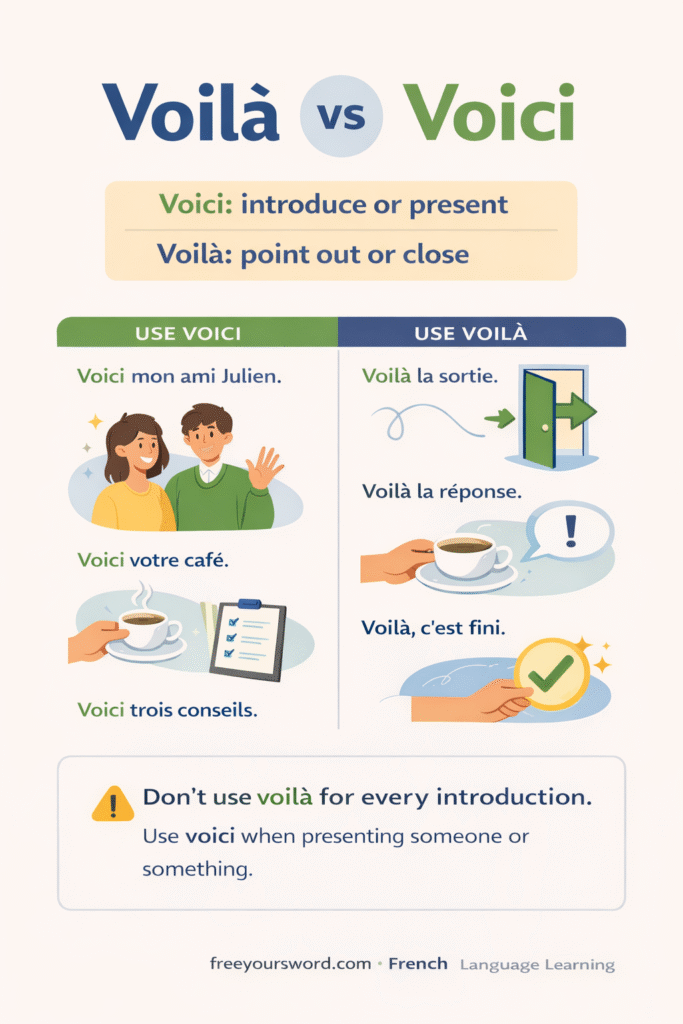
The core difference in one sentence
Use voici to introduce or present something.
Use voilà to point something out or to wrap up and confirm.
A simple mental model
- voici, introduction
- voilà, pointing out or closing
When to use voici
1) Introducing a person or a thing
Examples
- Voici mon ami Julien.
- Voici votre table.
- Voici le menu.
2) Handing something directly to someone
Examples
- Voici votre café.
- Voici les documents.
- Voici votre passeport.
3) Introducing an explanation or a list
Examples
- Voici trois raisons d’apprendre le français.
- Voici ce que tu dois faire.
- Voici comment ça marche.
When to use voilà
1) Pointing to something already there
Examples
- Voilà la sortie.
- Voilà la gare.
- Voilà la réponse.
2) Referring back to what you just said
Examples
- Voilà ce que je voulais dire.
- Voilà pourquoi je suis parti.
- Voilà ce que j’ai compris.
3) Closing, confirming, or saying “done”
Examples
- Voilà, c’est fini.
- Voilà, on y est.
- Voilà, tu comprends maintenant.
Quick comparison table
Use voici when
- you present, introduce, or announce something
- you hand something over
- you start a list or explanation
Use voilà when
- you point something out
- you refer back to a point you just made
- you close, confirm, or signal completion
Common mistakes and how to fix them
Mistake 1, using voilà for everything
People will understand, but it sounds less polished. For introductions, voici is usually better.
- Better: Voici mon ami.
Mistake 2, thinking it is only about distance
Distance helps, but intention matters more. If you are introducing something, voici often fits best, even if it is not physically close.
Mistake 3, missing the “closing” meaning of voilà
Voilà is not only “there it is”. It is also “that’s it”, “done”, “exactly”.
Mini practice
Choose voilà or voici
- ___ mon téléphone.
- ___, on a terminé.
- ___ la gare.
- ___ trois conseils pour progresser.
- ___ votre monnaie.
Deja un comentario