
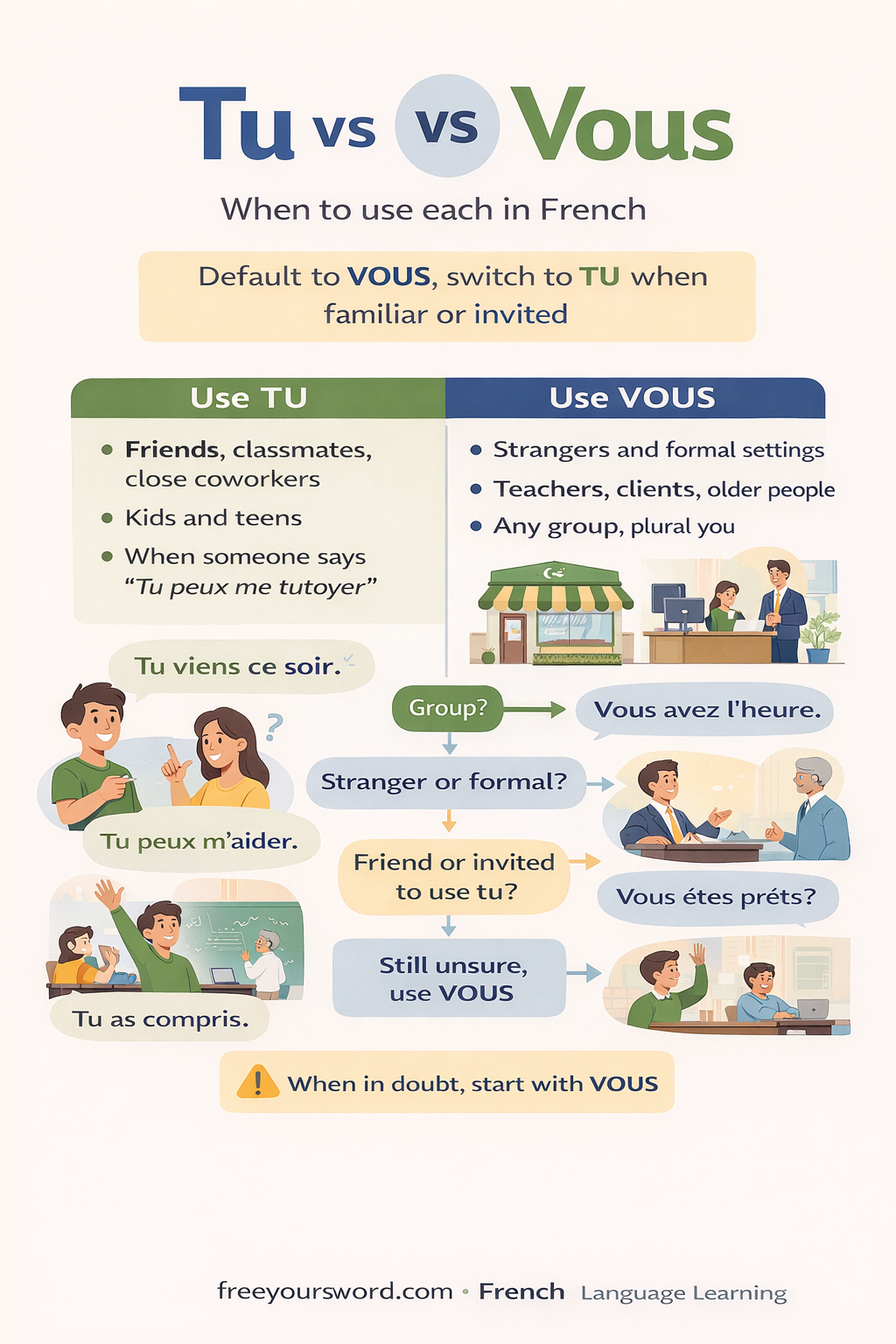
A practical guide to formality, rules, and real situations
Introduction
If you are learning French, “tu vs vous” is one of the first things that can make conversations feel stressful. The good news is that native speakers are usually forgiving. Still, choosing the right one helps you sound natural, polite, and confident. This guide gives you simple rules, real examples, common mistakes, and a quick practice quiz.
What “tu” and “vous” mean
Tu
“Tu” means “you” when speaking to one person in an informal context. It signals closeness, familiarity, or equal status.
Vous
“Vous” can mean two things:
- “You” in a formal context, even with one person.
- “You” plural, when speaking to two or more people, formal or informal.
The simplest rule
Use vous by default with adults you do not know.
Switch to tu when there is clear familiarity or someone invites you to.
A useful mindset:
Start polite, then relax.
When to use “vous”
1) With strangers and in most professional settings
Examples
- Bonjour, comment allez vous
- Excusez moi, vous avez l’heure
- Vous travaillez ici
2) With older people, teachers, clients, and authority figures
Examples
- Madame, vous pouvez répéter
- Monsieur, vous souhaitez un reçu
- Professeur, vous avez un moment
3) When you want distance or respect, even with someone your age
Examples
- Je voudrais vous poser une question
- Je préfère que vous me tutoyiez plus tard
When to use “tu”
1) With friends, close coworkers, classmates, and people your age in casual contexts
Examples
- Salut, comment ça va
- Tu viens ce soir
- Tu peux m’aider
2) With children and teenagers in most situations
Examples
- Tu t’appelles comment
- Tu as faim
3) When someone explicitly suggests it
Common phrases you will hear
- On peut se tutoyer
- Tu peux me tutoyer
When you hear that, switching to tu is usually expected.
Real life decision guide
Use this quick decision flow:
- Is it a group of people
If yes, use vous. - Is it a stranger, a client, a teacher, or a formal context
If yes, use vous. - Is it a friend, a close peer, or someone told you “tu peux me tutoyer”
If yes, use tu. - Still unsure
Use vous. It is safer.
Common situations with examples
At a café
Formal, safe option
- Bonjour, vous voulez quoi
- Vous prenez quelque chose
Friendly and informal, if the vibe is clearly casual
- Tu veux quoi
This is more common among peers, not always with customers.
At work
To a client
- Je vous envoie le document aujourd’hui
To a teammate you are close with - Tu peux regarder ça vite fait
In a classroom
To your teacher
- Vous pouvez expliquer encore une fois
To your classmate - Tu as compris l’exercice
In dating and social events
Often tu, but it depends. Some people start with vous to be playful or polite, then switch.
- On peut se tutoyer
- Tu peux me tutoyer
Common mistakes and how to fix them
Mistake 1, switching too fast to “tu”
Fix: start with vous, wait for social signals, or ask.
A simple question:
- On peut se tutoyer
Mistake 2, forgetting that “vous” is also plural
Fix: if you are speaking to two or more people, vous is correct even if everyone is your friend.
- Vous êtes prêts
Mistake 3, mixing forms in the same sentence
Wrong mix
- Tu êtes prêt
Fix: keep agreement consistent - Tu es prêt
- Vous êtes prêt, or prête, or prêts, or prêtes
Mini practice quiz
Choose tu or vous.
- Speaking to one stranger in the street: ___ avez l’heure
- Talking to a close friend: ___ viens ce soir
- Talking to two friends: ___ êtes prêts
- Speaking to your teacher: ___ pouvez répéter
- Someone says “Tu peux me tutoyer”: you should use ___
Answers
- vous
- tu
- vous
- vous
- tu
FAQ
Is it rude to use “vous” with a friend
Not necessarily. It can feel distant or overly formal, but it can also be playful or respectful depending on the relationship.
What if I use the wrong one
Most people will understand and forgive it, especially if you are not a native speaker. If you want to be safe, use vous.
When should I switch from vous to tu
When the relationship becomes familiar, or when the other person suggests it directly. If you are unsure, you can ask “On peut se tutoyer”.
Is it rude to use “vous” with a friend
Not necessarily. It can feel distant or overly formal, but it can also be playful or respectful depending on the relationship.
What if I use the wrong one
Most people will understand and forgive it, especially if you are not a native speaker. If you want to be safe, use vous.
When should I switch from vous to tu
When the relationship becomes familiar, or when the other person suggests it directly. If you are unsure, you can ask “On peut se tutoyer”.
Deja un comentario