
The French R can feel impossible at first, especially if your native language is Spanish or English. The good news is that it is a physical skill, not a talent. You can learn it with the right mouth position and short daily drills. This guide shows you how, with clear steps and practice words.
What the French R actually is
In standard French, the R is usually a throat sound produced in the back of the mouth, near the uvula. Many learners try to roll it like Spanish “rr”. That is the most common mistake.
Quick idea
French R is closer to a soft “gargle” sound than a tongue roll.
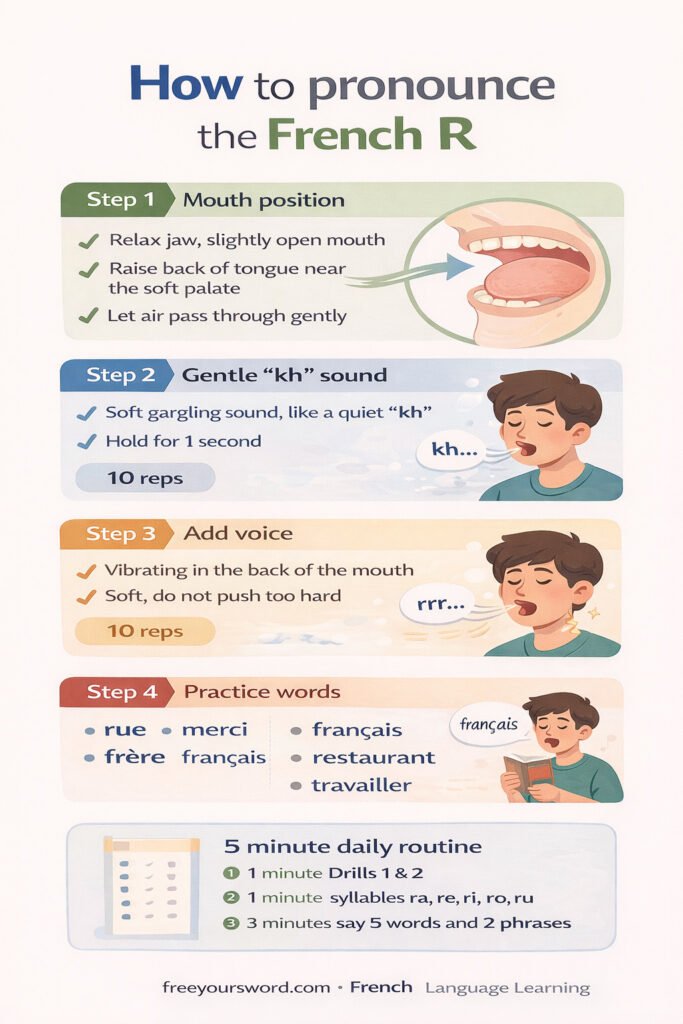
Step 1, set the correct mouth position
- Relax your jaw and keep your mouth slightly open.
- Place the back of your tongue high, close to the soft palate, but do not press hard.
- Let air flow out steadily.
You want friction, not a harsh cough.
Step 2, build the sound without words
Drill A, the quiet “kh” sound
Try to make a gentle “kh” like in some Arabic or Hebrew words, but softer.
Hold it for 1 second, then relax.
Do 10 reps.
Drill B, add voice
Now do the same sound but add voice, like vibrating lightly.
Do 10 reps.
Tip
If it turns into coughing, you are pushing too hard. Reduce force.
Step 3, practice with “R starter” syllables
Say these slowly, then faster:
- ra, re, ri, ro, ru
- rã, rẽ, rõ if you want nasal practice later
Do 3 rounds.
Step 4, practice with high frequency French words
Start with words where R is not surrounded by hard consonants.
Easy words
- rue
- revoir
- merci
- frère
- vraiment
Medium words
- français
- restaurant
- arriver
- travailler
French R in different positions
R at the beginning
- rue, revoir, rapide
Focus on starting the airflow first, then the R.
R in the middle
- arriver, travailler, toujours
Keep the airflow steady, do not “stop” the sound.
R at the end
- bonjour, savoir, hiver
End softly. Do not over pronounce it.
Common mistakes and fixes
Mistake 1, rolling R with the tongue
Fix: move the vibration to the back, near the throat.
Mistake 2, making it too harsh
Fix: less force. Think “friction”, not “cough”.
Mistake 3, losing the sound in fast speech
Fix: practice short phrases, not only single words.
10 short practice phrases
Say them slowly, then at normal speed.
- Bonjour, je m’appelle…
- Merci beaucoup.
- Je voudrais un café.
- Je suis en retard.
- Il travaille à Paris.
- C’est vraiment important.
- On va au restaurant.
- J’arrive tout de suite.
- Je préfère rester ici.
- Je retourne demain.
Mini practice routine, 5 minutes a day
- 1 minute, Drill A and B
- 2 minutes, syllables ra re ri ro ru
- 2 minutes, 5 words and 2 phrases
Do this for 7 days, you will feel the difference.
FAQ
Is it okay if my French R is not perfect
Yes. Many native speakers vary their R. Consistency matters more than perfection.
Do I need the uvular trill
No. Many speakers use a softer fricative. Aim for a natural back of throat sound.
Why do I cough
You are pushing too much air or tightening your throat. Reduce force and relax.
Deja un comentario