
French liaison is one of the fastest ways to sound more natural, but it also causes a lot of confusion. Sometimes it is required, sometimes optional, and sometimes it is flat out wrong. This guide gives you a simple system, real examples, and a quick practice test so you can use liaison with confidence.
What is liaison in French
Liaison happens when a normally silent final consonant at the end of a word is pronounced because the next word starts with a vowel sound. The sound “links” the two words.
Example
- les amis → pronounced like “lez ami”
The final s in les is normally silent, but before a vowel sound it becomes a z sound.
Important
Liaison is about the next word starting with a vowel sound, not just a vowel letter. Some words start with a silent h, which behaves like a vowel.
Why liaison matters
Liaison improves:
- rhythm and flow
- listening comprehension
- clarity in common phrases
But incorrect liaison can sound unnatural or even change meaning in rare cases.
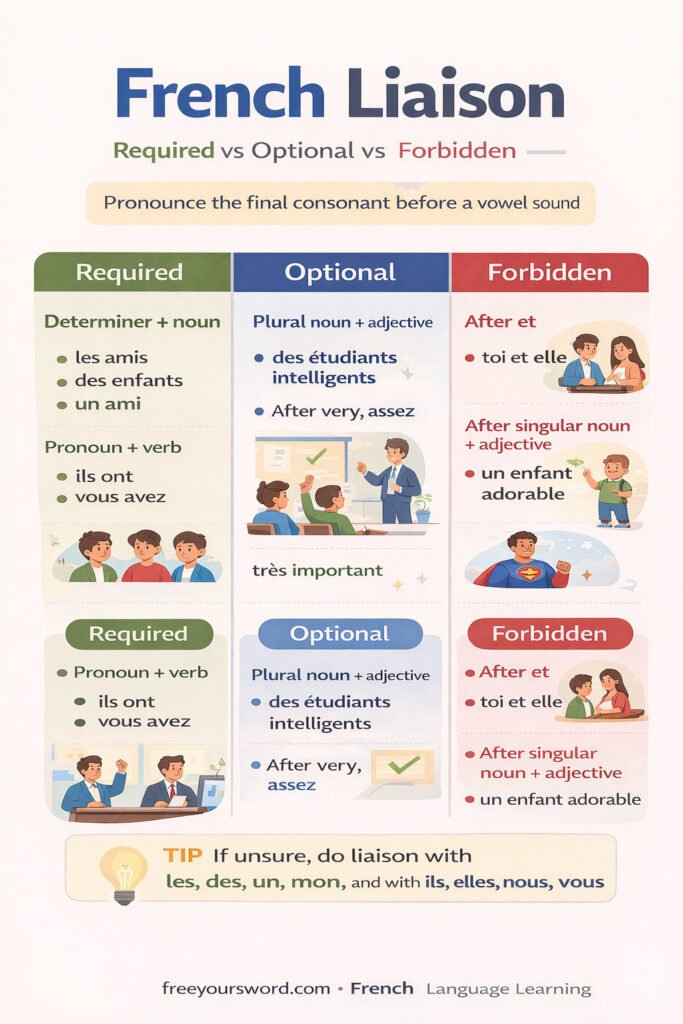
The 3 categories you must know
1) Required liaison
If you skip it, it sounds incorrect in standard French.
2) Optional liaison
You can do it or not. It depends on formality, speed, and personal style. Formal speech uses more optional liaisons.
3) Forbidden liaison
Doing it is considered incorrect.
Required liaison, the most common cases
A) Determiner + noun
This includes articles and possessives
Examples
- les amis
- des enfants
- un ami
- mon ami
- ces enfants
Common liaison sounds
- s or x → z, les amis, deux amis
- n → n, un ami
- t or d → t, grand homme is special, see later
B) Pronoun + verb
Examples
- ils ont
- elles ont
- on est
- nous avons
- vous avez
C) Fixed expressions
Examples
- de temps en temps
- États Unis
- tout à coup
Optional liaison, when it depends
A) After a plural noun
More formal
- des étudiants intelligents
Less formal - des étudiants intelligents without liaison on étudiants intelligents
B) After “être” and after many verbs
Examples
- ils sont arrivés
Formal speech may use liaison, casual speech often drops it.
C) Adverb endings, especially in formal style
Examples
- très intéressant
- assez important
Optional, but common in careful speech.
Forbidden liaison, don’t do these
These are the ones learners often get wrong.
A) After singular nouns
Example
- un étudiant intelligent
No liaison between étudiant and intelligent if étudiant is singular.
B) After “et”
Never liaison after et
- toi et elle
Not “toietelle” sound.
C) Before aspirated H words
Some words start with an “aspirated h”. It blocks liaison and often blocks elision too.
Examples
- les héros
- les haricots
No liaison, because h is aspirated in these words.
Tip
You cannot always guess aspirated h. The best solution is to learn common aspirated h words or check a dictionary that marks it.
A quick liaison cheat sheet
Use liaison almost always in:
- les, des, un, mon, ton, son, ces + noun
- ils, elles, nous, vous + verb
Optional in:
- after plural nouns
- after many verbs
- after very, assez, trop
Never in:
- after et
- after singular nouns + adjective
- before aspirated h words
Common liaison sounds with examples
s or x becomes z
- les amis
- deux enfants
- mes amis
n is pronounced as n
- un ami
- mon ami
- on est
t can appear as a linking sound
This happens in inversions and some set forms
- comment allez vous
- a t il
- y a t il
Common mistakes and how to fix them
Mistake 1, doing liaison after “et”
Fix: never liaison after et.
Mistake 2, doing liaison after a singular noun
Fix: singular noun + adjective is usually no liaison.
Mistake 3, ignoring aspirated H
Fix: learn the most common aspirated h words, and check dictionaries.
Mini practice quiz
Decide if liaison is required, optional, or forbidden.
- les amis
- toi et elle
- un ami
- ils ont
- des enfants adorables
- un enfant adorable
- les héros
- très important
- vous avez
- des étudiants intelligents
Answers
- required
- forbidden
- required
- required
- required between des enfants, optional between enfants adorables
- forbidden between enfant adorable
- forbidden because h is aspirated
- optional
- required
- required between des étudiants, optional between étudiants intelligents
FAQ
Is liaison always necessary
No. Some liaisons are required, some optional, and some are forbidden. The key is learning the frequent patterns.
Does liaison change spelling
No. Liaison affects pronunciation, not spelling.
How do I know if h is aspirated
Use a dictionary that marks aspirated h, and memorize common aspirated h words.
Deja un comentario